Reference
Ticket and Item Settings Reference
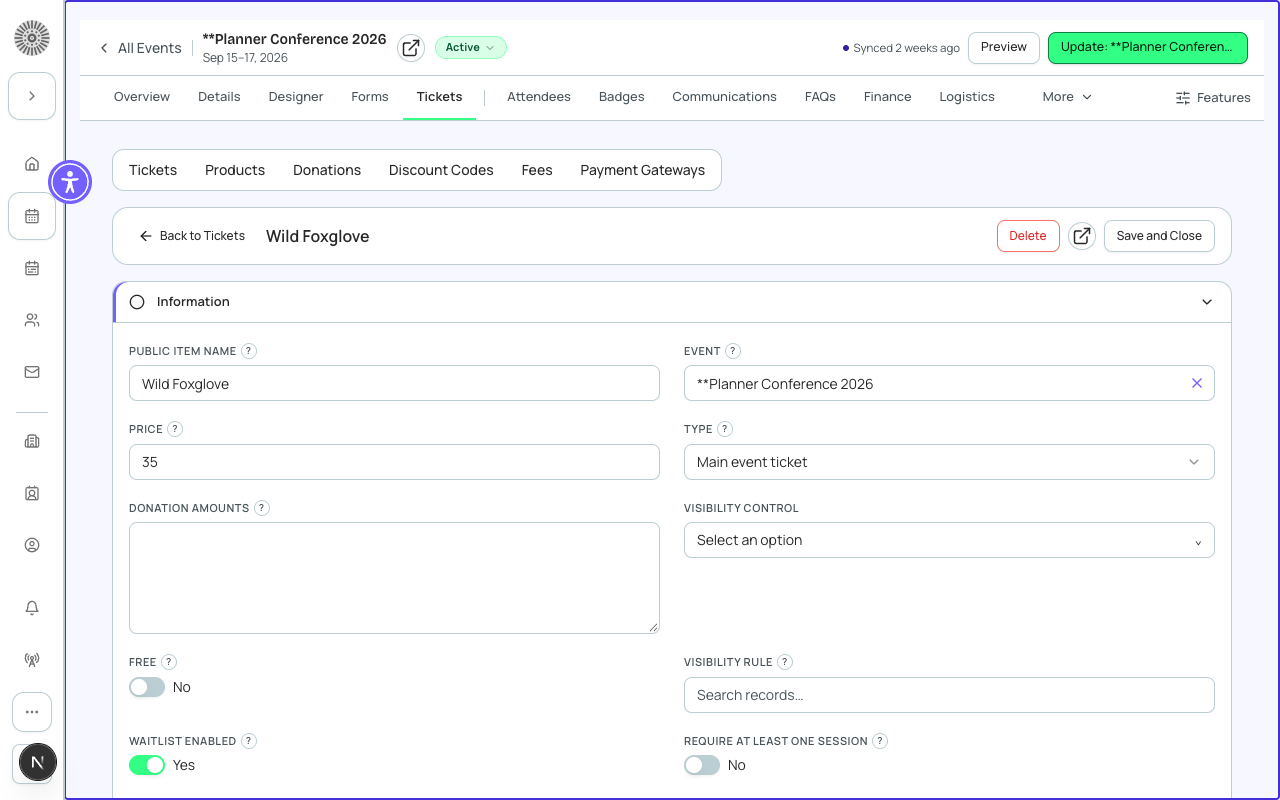
Tickets, donations, and products are all managed as Event Items — stored as `conference360__Event_Item__c` records in Salesforce. This reference covers every field available when you create or edit an item in the Tickets and Items tab.
Item Types
The Type field determines how an Event Item behaves during checkout and how revenue is categorized in reporting.
| Type | Use case | Donation mode | SF field value |
|---|---|---|---|
| Main event ticket | Standard event admission — general admission, VIP, early bird, etc. | No | Main event ticket |
| Donation | Allows registrants to include an optional or fixed charitable contribution at checkout | Yes | Donation |
| Guest | An additional attendee registered alongside the primary registrant | No | Guest |
| Other | Add-on merchandise or services — t-shirts, parking passes, meal upgrades, etc. | No | Other |
Core Fields
| Field | What it controls | Notes | SF field |
|---|---|---|---|
| Name | The ticket name shown to registrants on the checkout page and in emails | Keep concise — long names truncate on mobile screens | Name |
| Description | Optional marketing copy shown beneath the ticket name on the registration page | Supports a single line of plain text; not rich-text | conference360__Description__c |
| Type | Ticket, Donation, or Product — determines checkout behavior | Cannot be changed after the first purchase | conference360__Type__c |
| Price | The amount charged at checkout in the event currency | Set to 0 or enable Free to create a free ticket | conference360__Price__c |
| Free | When enabled, bypasses payment collection entirely for this item | Use instead of Price=0 to avoid showing a $0.00 line item in checkout | conference360__Free__c |
| Status | Planned, On Sale, Sold Out, Closed, or Unavailable — controls whether the item appears at checkout | Items not in On Sale status are hidden from the checkout form | conference360__Status__c |
| Quantity Available | The maximum number of this item that can be sold across all registrations | Leave blank for unlimited; set to a positive integer to enforce a cap | conference360__Quantity_Made_Available__c |
| Min Per Order | Minimum number of this item a single registrant must purchase | Typically 1 for regular tickets; set to 0 to make optional items truly optional | conference360__Minimum_Quantity__c |
| Max Per Order | Maximum number of this item a single registrant can purchase in one checkout | Useful for limiting bulk ticket purchases | conference360__Maximum_Quantity__c |
| Sort Order | Controls the display order of items on the registration page | Lower numbers appear first; items with equal sort order appear alphabetically | conference360__Sort_Order__c |
Sale Window
| Field | What it controls | Notes | SF field |
|---|---|---|---|
| Sale Start Date | The earliest date/time this item becomes purchasable | Leave blank to make the item available as soon as its Status is On Sale | conference360__Sales_Start_Date__c |
| Sale End Date | The cutoff after which this item can no longer be purchased | Items past their Sale End Date are automatically hidden from checkout | conference360__Sales_End_Date__c |
Early Bird Pricing
To set up early-bird pricing, create two ticket records with the same name prefix (e.g. 'GA — Early Bird' and 'GA — Standard'), set the early bird Sale End Date to your cutoff, and set the standard ticket Sale Start Date to the same moment. Only one will be visible to registrants at a time.
Visibility Rules
Visibility rules let you show or hide a ticket based on the registrant's form answers, their Salesforce record, or other ticket selections. Rules are built in the Visibility tab of the ticket editor and stored as `bt_base__Rule__c` records.
| Rule type | Description | Example |
|---|---|---|
| Form answer | Show/hide based on a specific answer to a registration form question | Show 'Staff Ticket' only if answer to 'Are you staff?' is 'Yes' |
| Ticket selection | Show/hide based on whether another ticket has been selected | Show 'Workshop Add-on' only if a conference ticket is in the cart |
| Contact field | Show/hide based on a field on the linked Salesforce Contact or Lead | Show 'Member Price' only if the Contact's Membership Status is Active |
Session Linking
Tickets can be linked to one or more sessions. When a registrant purchases a linked ticket they are automatically enrolled in those sessions — no separate session selection step is needed. This is useful for workshop passes or day-specific access.
Fees
Event-level and item-level fees can be attached to tickets. Fees are stored as `bt_stripe__Fee__c` records and are additive on top of the ticket price. There are exactly two fee types — Payment Processing (e.g. a credit card surcharge) and Tax — and both are expressed as a percentage, not a flat amount.
| Forge | SF Object | SF Field |
|---|---|---|
| Ticket / Item record | conference360__Event_Item__c | Name, conference360__Price__c, conference360__Type__c, conference360__Free__c, conference360__Status__c |
| Quantity cap | conference360__Event_Item__c | conference360__Quantity_Made_Available__c |
| Order limits | conference360__Event_Item__c | conference360__Minimum_Quantity__c, conference360__Maximum_Quantity__c |
| Sale window | conference360__Event_Item__c | conference360__Sales_Start_Date__c, conference360__Sales_End_Date__c |
| Visibility rules | bt_base__Rule__c / bt_base__Rule_Condition__c | Links to Event_Item__c via lookup |
| Fees | bt_stripe__Fee__c | Type__c (Payment Processing / Tax), Fee_Percentage__c |
Price changes after sales
Changing a ticket price after purchases have been made does not retroactively adjust existing transactions. Existing invoices retain the original price. Only new registrations will see the updated price.